

At some point, most creative people hit the same wall: the nagging feeling that every good idea has already been taken. You sit down to write, draw, or make something, and the blank page feels less like possibility and more like proof that you have nothing original to offer.
Austin Kleon wrote Steal Like an Artist in 2012 as a direct answer to that feeling. It is a short, illustrated book – barely 160 pages – aimed at anyone who wants to make things but feels stuck, intimidated, or unsure where to start. Kleon built his reputation as a poet and visual artist, and that creative background shows on every page.
This review looks at what the book says, how easy it is to read, and whether it gives you anything genuinely useful – or just a pleasant pep talk.
What Steal Like an Artist Is Really About
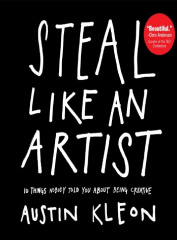
At heart, this is a book about permission. Its full title is Steal Like an Artist: 10 Things Nobody Told You About Being Creative, and its subtitle delivers the exact intentions of Kleon. He wants to shake off the existing images of real creativity-seriousness, about creating something ex nihilo.
His very reasoning is that nothing comes out of around. Every artist is endeared to all the things s/he read, watched, and absorbed by it. Stealing, as per Kleon, means studying the people one admires and letting their work feed one’s own.
The book is succinct and visually interesting, being filled with notes and sketches in giant hand-lettering rather than imposing paragraphs. It’s really good for a single afternoon.
Strongest points are some items or aspects to consider including being proactive about what influences you, maintaining a separate notebook purely for the sake of your hands as opposed to just storing everything on your laptop, and believing that side projects are just as important as the main project. Better to show up every day; inspiration isn’t as necessary as hard work. Of course, that’s the kind of advice most of us need to hear more than once.
What Works So Well About Kleon’s Advice
There’s a reason this book gets recommended so often to people who feel stuck before they’ve even started. Kleon keeps things short. Each chapter delivers one clear idea, and you’re done with it in minutes. That pace matters more than it sounds.
The tone feels like a friend talking, not a professor lecturing. Kleon admits he figured this out by doing, not by theorizing. That honesty is refreshing, and it makes the advice feel earned rather than borrowed.
Some of the ideas travel surprisingly far beyond visual art. The concept of building a “swipe file,” for instance, applies just as naturally to a blogger collecting writing styles they admire, or a content creator bookmarking video formats that click with them.
Beginners especially benefit here. Overthinking kills creative momentum, and Kleon’s framing, that influence is normal and even necessary, quietly removes a lot of that pressure. You stop waiting for originality to appear and start working instead.
Where the Book Feels Thin or Repetitive
Honesty requires admitting that the book is short – very short. At around 160 pages with large fonts, illustrations, and generous white space, you can finish it in a single afternoon. That’s fine for what it is, but some readers will close it wanting more.
The ideas themselves are genuinely good. The problem is that most of them stay at the surface. Kleon tells you to surround yourself with interesting work and keep a “swipe file” of things you love, but he rarely shows you how to build those habits over time. It reads more like an encouraging note than a practical guide.
Experienced creatives may feel like they’ve heard this before. If you’ve already read Steven Pressfield‘s The War of Art or any of Twyla Tharp’s work, Steal Like an Artist covers familiar ground with less depth.
Anyone hoping for a structured system will be disappointed. There’s no framework here, no exercises with real accountability. Think of it as a pep talk, not a curriculum.
Who Should Read It and What to Read Next

Beginners will get the most out of this book. If you’re just starting out as a writer, designer, musician, or maker of anything really, Steal Like an Artist hands you permission to learn through imitation without the guilt. Students especially tend to respond well to it. So do blocked creatives who’ve been staring at a blank page for too long.
It’s a friendly nudge rather than a structured course, so if you want deep craft instruction, look elsewhere. Bird by Bird by Anne Lamott or Big Magic by Elizabeth Gilbert covers similar emotional ground with more depth.
That said, if Kleon’s voice clicks with you, his follow-ups are worth picking up immediately. Show Your Work! tackles sharing your creative process publicly, and Keep Going is a quieter, steadier book about sustaining creativity over time. Both feel like natural extensions of this one.
Think of Steal Like an Artist as a quick mindset reset, not a masterclass. It’s short, honest, and genuinely useful for that.
A Small Book With a Useful Creative Spark
This is an informative read for a lazy afternoon, whereby one can afford time to reflect upon how it interacts with his or her own craft. Steal Like an Artist stands more as a gentle push, rather than a complete theory. It does not give a lot of details about style or solve fully the questions of what it means to be original and authentic in one’s work. However, by removing the impediments which often keep people from starting, it offers encouragement of sorts. Kleon’s style is extremely accessible and reassuring: one feels easy returning to the book. It may feel lightweight for those artsies who are into theory, but for someone not sure about starting, it plants explicit permission to get started and keep pushing.